The Sheriff Called Me About 40 Starving Horses on a Farm Outside Town. The Owner Was an 83-Year-Old Widow Who Met Us at the Gate With a Shotgun and Said, “Nobody Takes My Babies”
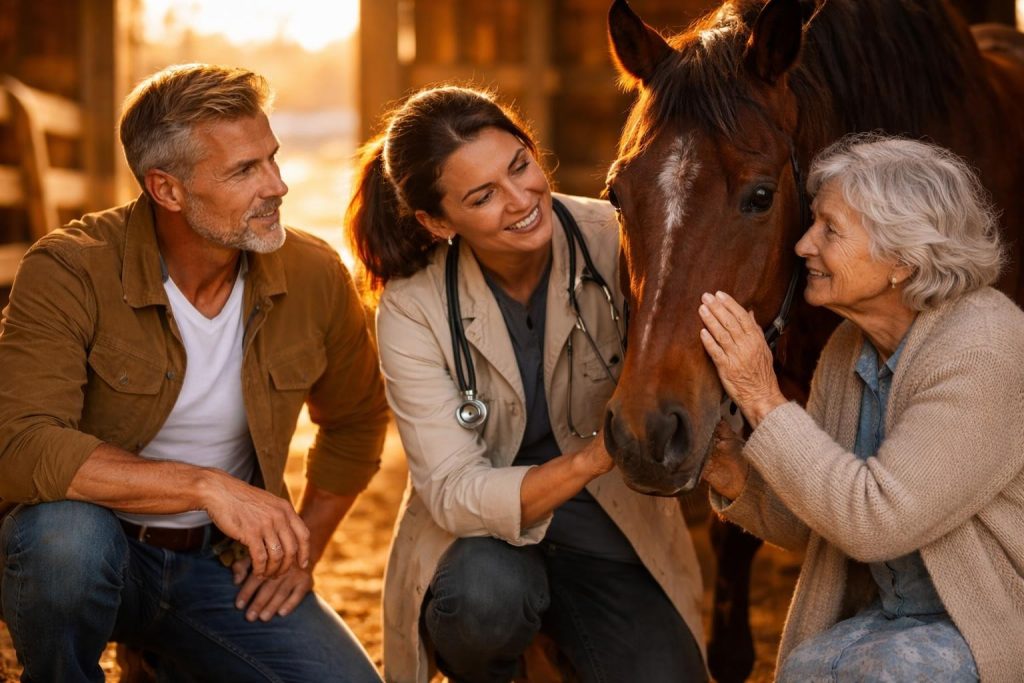
I called the veterinarian in McCook that afternoon.
Dr. Delfina Aldana came out with her truck and spent six hours in the Varner barn. Mrs. Varner followed her from horse to horse, telling her each one’s name, its mother’s name, its grandmother’s name.
There were forty-three horses.
Dr. Aldana scored every one on a body condition chart. Nine were in serious trouble. Thirty-one were thin but would recover with good feed. Three were fine. Mrs. Varner had been giving those three the best hay.
“Those were Orval’s,” she said. “His last three.”
The sheriff and the county attorney agreed to something unusual.
No seizure. No charges.
Instead, a voluntary agreement. Mrs. Varner would let me move the horses to my place for the rest of the winter. Dr. Aldana would treat them. And in the spring, we’d decide together what to do with them.
The hay alone would cost about thirty-eight thousand dollars.
I didn’t have thirty-eight thousand dollars lying around.
But Red Willow County did.
Word got out the way it does in a small town. A rancher I’d never met dropped off a semi-load of big round bales. The 4-H club held a pancake breakfast. The veterinary clinic cut its bill in half. A trucking company hauled the horses to my place for free.
We moved them in six loads.
Mrs. Varner rode with me in every one.
She came to my place every day that winter. I’d pick her up at eight and drive her home at five. She brushed the horses. She told me their stories. She ate lunch at my kitchen table and told me stories about Orval, too.
By March, the nine in serious trouble had all pulled through.
By April, you couldn’t see a single hip bone.
Then it was time for the hard part.