My Ranch Hand Found a Dinosaur Skull in a Montana Washout. A Private Collector Offered $8 Million for It. A Museum Offered $400,000. My Grandson Asked Me Which One Would Let Him See It Again
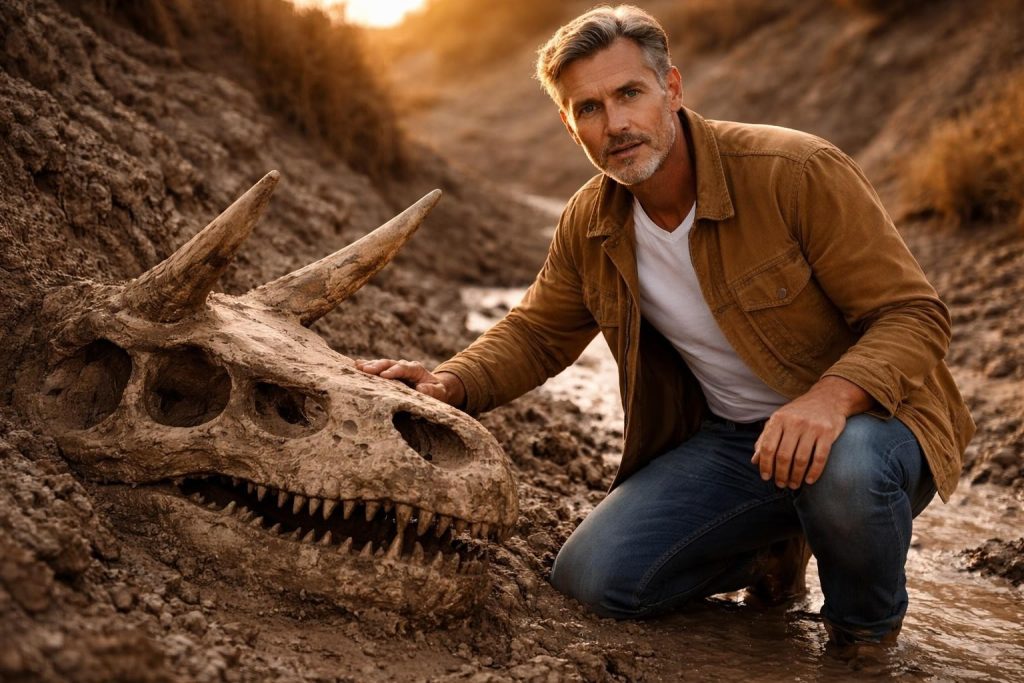
My name is Rance Brekkestad. I’m fifty-four, widowed for six years, and my family has run cattle on thirty thousand acres in Garfield County, Montana, since 1910. It’s hard, empty, beautiful country. Hell Creek country. Famous among paleontologists for what’s buried in it.
Dr. Sunniva Holt arrived at midnight with two graduate students and a truck full of plaster and burlap.
Forty-eight. Wide-brimmed hat. Sun-creased face. Twenty years of digging dinosaurs in eastern Montana.
She stood in the washout with a headlamp and didn’t say anything for ten minutes.
Then she sat down in the mud and laughed.
“Mr. Brekkestad,” she said. “This is the most complete Triceratops skull I’ve ever seen. Maybe the most complete anywhere.”
The excavation took six weeks.
Her team worked in the heat with brushes, dental picks, and buckets of plaster. They uncovered a skull more than seven feet long, both horns, the full frill, and part of the neck and shoulders.
Word got out.
In week three, a man in a rented SUV drove up my ranch road. Expensive boots. An accent from somewhere far away. He represented a private collector.
“My client would like to make an offer,” he said.
“For what?”
“For the specimen,” he said. “In Montana, fossils on private land belong to the landowner. My client is prepared to pay eight million dollars.”
Eight million.
The next week, the director of a natural history museum in Bozeman called. They’d love to acquire the skull. They had raised what they could.
“Four hundred thousand dollars,” she said. “I know it’s not competitive.”
That night, my grandson, who was staying with me for the summer, sat at the kitchen table eating cereal.
He’s nine. He’d watched Dr. Holt’s team every day.
“Grandpa,” he said. “If you sell it to the man in the SUV, where does it go?”